

The paradoxes of adaptation to climate change in Central Asia
Vadim Yapiyev a , Zarina Saidaliyeva a,b , Nurlan Ongdas a,c
a National Laboratory Astana, Nazarbayev University, 53 Kabanbay batyr avenue, Astana, Kazakhstan
b Central Asian Regional Glaciological Centre under the auspices of UNESCO, Almaty, 050010, Kazakhstan
c Nazarbayev University Research Administration, Nazarbayev University, 53 Kabanbay batyr avenue, Astana, Kazakhstan
https://doi.org/10.29258/CAJWR/2026-R1.v12-2/26-42.eng
Corresponding author e-mail: vyapiyev@nu.edu.kz
Thematic cluster: Climate & Environment
Type of paper: Opinion paper
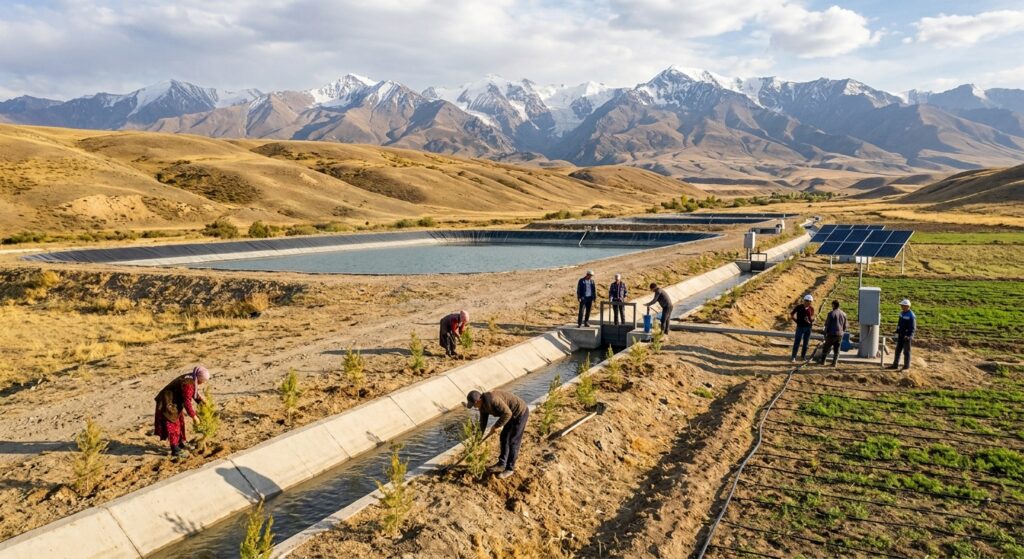
Photo: AI
Abstract
Central Asia is widely recognized as a global ‘hotbed’ of climate change (CC), yet effective adaptation is hindered by systemic contradictions. Despite the region’s high vulnerability to CC it remains a significant scientific “blind spot” in global research on its impacts. In this paper we look at the dominant narratives highly relevant to climate change adaptions (CCA) though the lens of “adaptation paradoxes”— situations where policies, discourses, interventions, or measures intended designed to reduce vulnerability or mitigate the impacts of CC inadvertently generate new risks or reproduce existing structural problems. We examine eight interconnected paradoxes: geography, water security, climate change, the Aral Sea, glacier retreat, data sharing, parachute science, and sustainable development. By centering on these paradoxes, we argue that adaptation challenges are manifestations of deep structural contradictions embedded in the region’s history, geography, and climate. Ultimately, we propose that Central Asia must be viewed not only a region in environmental crisis but serves as a critical laboratory for understanding the complexities of building resilience in water-scarce, politically fragmented landscapes.
Available in English
Download the article (eng)For citation:
Yapiyev, V., Saidaliyeva, Z., & Ongdas, N. (2026). The paradoxes of adaptation to climate change in Central Asia. Central Asian Journal of Water Research, 12(2), 26–42. https://doi.org/10.29258/CAJWR/2026-R1.v12-2/26-42.eng
References
Ayers, J. (2011). Resolving the Adaptation Paradox: Exploring the Potential for Deliberative Adaptation Policy-Making in Bangladesh. Global Environmental Politics, 11(1), 62–88. https://doi.org/10.1162/GLEP_a_00043
Borgomeo, E. (2026). The paradoxes holding back progress on water security. Nature Water, 4(3), 287–293. https://doi.org/10.1038/s44221-026-00598-w
Chen, J. L., Pekker, T., Wilson, C. R., Tapley, B. D., Kostianoy, A. G., Cretaux, J.-F., & Safarov, E. S. (2017). Long-term Caspian Sea level change. Geophysical Research Letters, 44(13), 6993–7001. https://doi.org/10.1002/2017GL073958
Chu-Talas Commission. (2018). Transboundary diagnostic analysis on Chu and Talas river basins (In Russian). In Commission of the Republic of Kazakhstan and the Kyrgyz Republic on the Use of Water Management Facilities of Intergovernmental Status on the rivers Chu and Talas.
De Cordier, B., & Van den Bosch, J. J. J. (2021). Defining and delineating Central Asia from a European perspective. In The European handbook of Central Asian studies: history, politics, and societies (pp. 13–37). ibidem Verlag.
Duku, J., Tourian, M. J., Azarderakhsh, M., Abbasov, R., Mehran, A., Haghighi, A. T., Xenarios, S., Boschee, A., Babagiray, S., Sadegh, M., Shokri, N., Nazemi, A., Farahmand, A., Ashraf, S., Khujanazarov, T., Hassanzadeh, E., Najib, D., Placht, D., Mashtayeva, S., … AghaKouchak, A. (2026). The Shrinking Caspian Sea: Eco‐Hydrological Responses to Human and Climate Pressures. Earth’s Future, 14(6), 1–17. https://doi.org/10.1029/2025EF008028
Dupuis, J., & Knoepfel, P. (2013). The adaptation policy paradox: the implementation deficit of policies framed as climate change adaptation. Ecology and Society, 18(4).
Falkenmark, M., & Rockström, J. (2006). The New Blue and Green Water Paradigm: Breaking New Ground for Water Resources Planning and Management. Journal of Water Resources Planning and Management, 132(3), 129–132. https://doi.org/10.1061/(ASCE)0733-9496(2006)132:3(129)
Gascoin, S. (2024). A call for an accurate presentation of glaciers as water resources. WIREs Water, 11(2), 1–8. https://doi.org/10.1002/wat2.1705
Huss, M., & Hock, R. (2018). Global-scale hydrological response to future glacier mass loss. Nature Climate Change, 8(2), 135–140. https://doi.org/10.1038/s41558-017-0049-x
Hydrological Sciences | Is the Caspian Sea Going to Experience Aral Sea Syndrome? (2024). https://blogs.egu.eu/divisions/hs/2024/07/25/caspian-sea-aral-sea-syndrome/
IPCC. (2023). Summary for Policymakers. In Climate Change 2022 – Impacts, Adaptation and Vulnerability (pp. 3–34). Cambridge University Press. https://doi.org/10.1017/9781009325844.001
Jiang, J., Zhou, T., Wang, H., Qian, Y., Noone, D., & Man, W. (2020). Tracking Moisture Sources of Precipitation over Central Asia: A Study Based on the Water-Source-Tagging Method. Journal of Climate, 33(23), 10339–10355. https://doi.org/10.1175/JCLI-D-20-0169.1
Kaser, G., Großhauser, M., Marzeion, B., & Barry, R. G. (2010). Contribution potential of glaciers to water availability in different climate regimes. Proceedings of the National Academy of Sciences of the United States of America, 107(47), 20223–20227. https://doi.org/10.1073/pnas.1008162107
Khaibullina, Z., Amantaikyzy, A., Ariphanova, D., Temirbayeva, R., Mitusov, A., & Zhurumbetova, Z. (2022). Socio-economic and public health impacts of climate change and water availability in Aral District, Kyzylorda Region, Kazakhstan. Central Asian Journal of Water Research, 8(1), 177–204. https://doi.org/10.29258/CAJWR/2022-R1.v8-1/177-204.eng
Khanal, S., Lutz, A. F., Kraaijenbrink, P. D. A., van den Hurk, B., Yao, T., & Immerzeel, W. W. (2021). Variable 21st Century Climate Change Response for Rivers in High Mountain Asia at Seasonal to Decadal Time Scales. Water Resources Research, 57(5), 1–26. https://doi.org/10.1029/2020WR029266
Koriche, S. A., Singarayer, J. S., & Cloke, H. L. (2021). The fate of the Caspian Sea under projected climate change and water extraction during the 21st century. Environmental Research Letters, 16(9), 094024. https://doi.org/10.1088/1748-9326/ac1af5
Kraaijenbrink, P. D. A., Stigter, E. E., Yao, T., & Immerzeel, W. W. (2021). Climate change decisive for Asia’s snow meltwater supply. Nature Climate Change, 11(July). https://doi.org/10.1038/s41558-021-01074-x
Marti, B., Yakovlev, A., Karger, D. N., Ragettli, S., Zhumabaev, A., Wakil, A. W., & Siegfried, T. (2023). CA-discharge: Geo-Located Discharge Time Series for Mountainous Rivers in Central Asia. Scientific Data, 10(1), 579. https://doi.org/10.1038/s41597-023-02474-8
Micklin, P. (2016). The future Aral Sea: hope and despair. Environmental Earth Sciences, 75(9), 844. https://doi.org/10.1007/s12665-016-5614-5
Overland, I., Jalilov, S.-M., & Vakulchuk, R. (2025). Afghanistan’s Qosh Tepa irrigation project: implications for transboundary water management in Central Asia. Environmental Research: Water, 1(4), 043001. https://doi.org/10.1088/3033-4942/ae36ca
Pachauri, R. K., Allen, M. R., Barros, V. R., Broome, J., Cramer, W., Christ, R., Church, J. A., Clarke, L., Dahe, Q., & Dasgupta, P. (2014). Climate change 2014: synthesis report. Contribution of Working Groups I, II and III to the fifth assessment report of the Intergovernmental Panel on Climate Change. Ipcc.
Saidaliyeva, Z., Muccione, V., Shahgedanova, M., Bigler, S., Adler, C., & Yapiyev, V. (2024). Adaptation to climate change in the mountain regions of Central Asia: A systematic literature review. WIREs Climate Change, (April), 1–26. https://doi.org/10.1002/wcc.891
Saidaliyeva, Z., Shahgedanova, M., Yapiyev, V., Wade, A. J., Akbarov, F., Esenaman uulu, M., Kalashnikova, O., Kapitsa, V., Kasatkin, N., Rakhimov, I., Satylkanov, R., Sayakbaev, D., Semakova, E., Severskiy, I., Petrov, M., Umirzakov, G., & Usubaliev, R. (2024). Precipitation in the mountains of Central Asia: isotopic composition and source regions. Atmospheric Chemistry and Physics, 24(21), 12203–12224. https://doi.org/10.5194/acp-24-12203-2024
Shahgedanova, M., Saidaliyeva, Z., Mussina, A., Kapitsa, V., Raimbekova, Z., Donskikh, D., Kissebayev, D., Kasenov, M., & Petrov, M. (2024). Debris flows in the northern Tien Shan, Central Asia: regional database, meteorological triggers, and trends. Npj Natural Hazards, 1(1), 49. https://doi.org/10.1038/s44304-024-00050-7
Stefanoudis, P. V., Licuanan, W. Y., Morrison, T. H., Talma, S., Veitayaki, J., & Woodall, L. C. (2021). Turning the tide of parachute science. Current Biology, 31(4), R184–R185. https://doi.org/10.1016/J.CUB.2021.01.029
Symbolic, But Distant in the Future: A Dam on Kyrgyzstan’s Naryn River – Аналитический интернет-журнал Власть. (2024). https://vlast.kz/english/60030-symbolic-but-distant-in-the-future-a-dam-on-kyrgyzstans-naryn-river.html
Vakulchuk, R., Daloz, A. S., Overland, I., Sagbakken, H. F., & Standal, K. (2023). A void in Central Asia research: climate change. Central Asian Survey, 42(1), 1–20. https://doi.org/10.1080/02634937.2022.2059447
van Tiel, M., Aubry-Wake, C., Somers, L., Andermann, C., Avanzi, F., Baraer, M., Chiogna, G., Daigre, C., Das, S., Drenkhan, F., Farinotti, D., Fyffe, C. L., de Graaf, I., Hanus, S., Immerzeel, W., Koch, F., McKenzie, J. M., Müller, T., Popp, A. L., … Yapiyev, V. (2024). Cryosphere–groundwater connectivity is a missing link in the mountain water cycle. Nature Water, 2(7), 624–637. https://doi.org/10.1038/s44221-024-00277-8
Viviroli, D., Drenkhan, F., Scott, C. A., Somers, L., & van Tiel, M. (2026). Cascading downstream impacts of water cycle changes in mountain regions. Nature Climate Change, 16(2), 129–142. https://doi.org/10.1038/s41558-025-02552-2
Wade, A. J., Yapiyev, V., Shahgedanova, M., Saidaliyeva, Z., Madibekov, A., Kapitsa, V., Kasatkin, N., Ismukhanova, L., Kulbekova, R., Sultanbekova, B., Severskiy, I., Esenaman, M., Kalashnikova, O., Usubaliev, R., Akbarov, F., Umirzakov, G., Petrov, M., Rakhimov, I., Kayumova, D., & Kayumov, A. (2024). Cryosphere and land cover influence on stream water quality in Central Asia’s glacierized catchments. Science of The Total Environment, 939, 173525. https://doi.org/10.1016/j.scitotenv.2024.173525
Water conflict and cooperation between India and Pakistan | Climate-Diplomacy. (2025). https://climate-diplomacy.org/case-studies/water-conflict-and-cooperation-between-india-and-pakistan
Wegerich, K. (2008). Hydro-hegemony in the Amu Darya Basin. Water Policy, 10(S2), 71–88. https://doi.org/10.2166/wp.2008.208
Xenarios, S., Assubayeva, A., Xie, L., Sehring, J., Amirkhanov, D., Sultanov, A., & Fazli, S. (2021). A bibliometric review of the water security concept in Central Asia. Environmental Research Letters, 16(1), 013001. https://doi.org/10.1088/1748-9326/abc717
Xenarios, S., Orazgaliyev, S., Torabi Haghighi, A., & Kløve, B. (2025). A perspective on sustainability and environmental challenges in the Caspian Sea. International Journal of Water Resources Development, 41(1), 1–8. https://doi.org/10.1080/07900627.2025.2441052
Xenarios, S., Schmidt-Vogt, D., Qadir, M., Janusz-Pawletta, B., & Abdullaev, I. (2019). The aral sea basin: Water for sustainable development in central asia. In The Aral Sea Basin: Water for Sustainable Development in Central Asia. Taylor and Francis. https://doi.org/10.4324/9780429436475
Yapiyev, V., Gilman, C. P., Kabdullayeva, T., Suleimenova, A., Shagadatova, A., Duisembay, A., Naizabekov, S., Mussurova, S., Sydykova, K., Raimkulov, I., Kabimoldayev, I., Abdrakhmanova, A., Omarkulova, S., Nurmukhambetov, D., Kudarova, A., Malgazhdar, D., Schönbach, C., & Inglezakis, V. (2018a). Top soil physical and chemical properties in Kazakhstan across a north-south gradient. Scientific Data, 5, 1–8. https://doi.org/10.1038/sdata.2018.242
Yapiyev, V., Ongdas, N., Saidaliyeva, Z., Zhiyenbek, A., Smogulova, T., Baigaliyeva, M., & Prikaziuk, E. (2025). Baseline information and regionalization of the large river basins of Kazakhstan. Frontiers in Water, 7, 1601671. https://doi.org/10.3389/frwa.2025.1601671
Yapiyev, V., Sagintayev, Z., Inglezakis, V., Samarkhanov, K., & Verhoef, A. (2017). Essentials of Endorheic Basins and Lakes: A Review in the Context of Current and Future Water Resource Management and Mitigation Activities in Central Asia. Water, 9(10), 798. https://doi.org/10.3390/w9100798
Yapiyev, V., Wade, A. J., Shahgedanova, M., Saidaliyeva, Z., Madibekov, A., & Severskiy, I. (2021). The hydrochemistry and water quality of glacierized catchments in Central Asia: A review of the current status and anticipated change. Journal of Hydrology: Regional Studies, 38, 100960. https://doi.org/10.1016/j.ejrh.2021.100960
Zinzani, A. (2015). The logics of water policies in Central Asia: The IWRM implementation in Uzbekistan and Kazakhstan (Vol. 23). LIT Verlag Münster.
Central Asia, climate change adaptation, paradoxes, water security